Education
/
Feb 6, 2026
The Future of Peptide Research: Emerging Compounds and Next-Generation Discoveries
The Breakthroughs You Haven't Heard About Yet
The peptide research landscape in 2026 looks nothing like it did five years ago. GLP-1 agonists dominate headlines, but the real breakthroughs — the ones that will define the next decade — are happening in labs most people have never heard of.
We're witnessing a convergence of advances in delivery technology, computational design, and biological understanding that is fundamentally expanding what peptide research can achieve. The compounds making headlines today are just the opening chapter.
Here's where the science is heading — and what researchers should be watching.
The GLP-1 Revolution: Just the Beginning
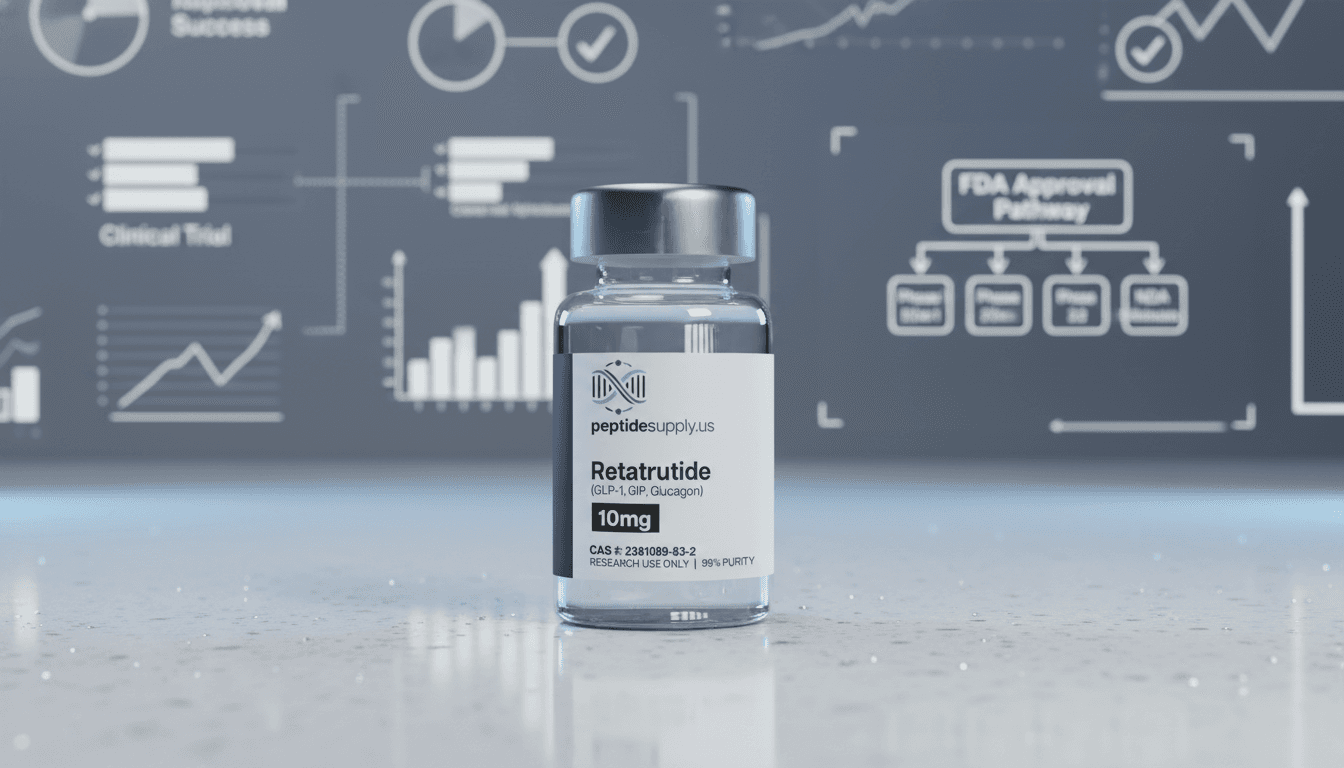
The GLP-1 receptor agonist story is the most visible example of peptide research entering the mainstream. Semaglutide, tirzepatide, and retatrutide have demonstrated what targeted peptide signaling can achieve in large-scale clinical trials.
But the GLP-1 class represents a proof of concept, not a ceiling.
The progression tells the story: single agonism (semaglutide targeting GLP-1 receptors alone) gave way to dual agonism (tirzepatide targeting GLP-1 and GIP receptors), which gave way to triple agonism (retatrutide targeting GLP-1, GIP, and glucagon receptors). Each generation showed incrementally greater effects in clinical research.
Where does this lead? Researchers are now exploring quad-agonist compounds targeting four or more metabolic pathways simultaneously. The principle is clear: multi-target peptides that work with the body's existing signaling systems represent a fundamentally different approach than single-target pharmaceuticals.
The market trajectory reflects this potential. Peptide therapeutics are projected to exceed $50 billion by 2030, making them the fastest-growing pharmaceutical category globally. That investment is funding research pipelines that will produce the next generation of discoveries.
Oral Peptide Delivery: The Game-Changing Frontier
For decades, peptide research was limited by a fundamental problem: peptides are digested by stomach acid and enzymes before they can be absorbed. This meant subcutaneous administration was the default for virtually all peptide compounds.
That barrier is falling.
Oral semaglutide (Rybelsus) proved that peptide oral delivery is commercially viable. It uses an absorption enhancer called SNAC (sodium N-[8-(2-hydroxybenzoyl)amino]caprylate) to facilitate gastric absorption. The approach isn't perfect — oral bioavailability remains lower than subcutaneous delivery — but it demonstrated the concept at scale.
Next-generation oral delivery research is advancing on multiple fronts:
Nanoparticle encapsulation wraps peptides in protective shells that resist stomach acid and release their payload in the intestine where absorption is more efficient. Published research documents encapsulation efficiencies exceeding 85% for certain peptide types.
Permeation enhancers temporarily and reversibly increase intestinal membrane permeability, allowing intact peptides to cross into circulation. Several novel enhancers in preclinical research show 5-10x improvements in oral bioavailability compared to unenhanced formulations.
Mucoadhesive systems attach to the intestinal wall, extending contact time and improving absorption. These gel-forming polymers can maintain localized peptide concentrations for hours rather than the minutes available with standard oral delivery.
Enteric coatings with targeted release bypass the stomach entirely, delivering peptides to specific regions of the small intestine optimized for absorption. This site-specific approach addresses both the degradation and permeability challenges simultaneously.
If oral delivery research succeeds broadly, it transforms the entire peptide landscape — making compounds more accessible to researchers and eventually expanding therapeutic possibilities.
Multi-Target Peptides: Beyond Triple Agonism
The GLP-1 evolution from single to triple agonism illustrated a broader principle: peptides that engage multiple receptor systems simultaneously can produce effects greater than the sum of individual targets.
This concept is now being applied far beyond metabolic research.
Bi-functional healing peptides combine tissue repair signaling with anti-inflammatory activity in a single molecule. Instead of administering two separate compounds — as current research does with BPC-157 and TB-500 combinations — next-generation peptides may incorporate both mechanisms into one sequence.
Neuro-metabolic peptides target both central nervous system and peripheral metabolic pathways. Early research suggests that compounds addressing both brain signaling and metabolic function simultaneously may achieve outcomes neither approach achieves alone.
Immuno-regenerative peptides combine immune modulation (similar to Thymosin Alpha-1) with tissue repair properties. The immune system and regenerative processes are deeply interconnected — next-generation peptides may leverage both simultaneously.
The design challenge is significant: each additional target adds complexity to the molecule and increases the difficulty of maintaining selectivity. But advances in computational design are making multi-target peptide engineering increasingly feasible.
Mitochondrial-Derived Peptides: A New Class Emerges
Perhaps the most intellectually exciting frontier in peptide research is the discovery of mitochondrial-derived peptides (MDPs) — short peptides encoded within mitochondrial DNA rather than nuclear DNA.
MOTS-c (Mitochondrial Open Reading Frame of the Twelve S rRNA-c) was among the first identified. Research has documented its interactions with metabolic pathways, exercise physiology, and cellular energy regulation. But MOTS-c is just one member of a growing family.
Humanin, discovered in 2001, was the first identified MDP. Research has documented its role in cellular stress responses, with over 500 publications investigating its protective effects in various cellular models.
SHLP peptides (Small Humanin-Like Peptides 1-6) represent six additional MDPs discovered more recently. Each appears to have distinct biological activities. SHLP2 and SHLP3 have attracted particular research interest for their interactions with metabolic and age-related pathways.
What makes MDPs fascinating is their evolutionary origin. Mitochondrial DNA is ancient — inherited from the bacterial endosymbiont that became the powerhouse of eukaryotic cells over a billion years ago. These peptides represent a signaling system that predates most of our nuclear-encoded hormones and growth factors.
The implication: we may have an entirely unexplored pharmacological library encoded in our own mitochondrial genome, with functions we're only beginning to characterize.
Note: The research cited in this article is presented for educational purposes. All PeptideSupply products are sold for research use only.
Peptide-Drug Conjugates: Precision Targeting
Peptide-drug conjugates (PDCs) represent the marriage of peptide specificity with pharmacological potency. The concept: use a peptide's natural receptor-targeting ability to deliver a therapeutic payload directly to specific cell types, reducing systemic exposure and off-target effects.
This isn't theoretical — antibody-drug conjugates (ADCs) using a similar principle have already produced FDA-approved cancer treatments. PDCs offer potential advantages over ADCs: smaller molecular size, better tissue penetration, lower immunogenicity, and simpler manufacturing.
Current PDC research is exploring:
GLP-1 receptor-targeted conjugates that deliver anti-inflammatory compounds specifically to metabolically active tissues
Integrin-targeting peptides conjugated with imaging agents for diagnostic applications
Somatostatin analog conjugates delivering cytotoxic payloads to neuroendocrine tumor cells
RGD peptide conjugates targeting tumor vasculature with anti-angiogenic agents
The precision is remarkable. In published research, PDCs have demonstrated 10-100x improvements in target-tissue drug concentration compared to unconjugated delivery, with corresponding reductions in systemic side effects.
AI-Designed Peptides: When Machines Do the Chemistry
Artificial intelligence is transforming peptide discovery from a slow, iterative experimental process into something closer to engineering.
Traditional peptide discovery: synthesize a library of variants, test them all, identify the best performers, modify, repeat. This process takes years and thousands of experimental cycles.
AI-accelerated discovery: train machine learning models on existing structure-activity data, predict which sequences will have desired properties, synthesize only the top candidates, validate. This process takes months with dramatically fewer experimental cycles.
Several breakthrough applications are already producing results:
Binding affinity prediction — AI models can now predict how strongly a peptide will bind to a given receptor with accuracy approaching experimental measurement. This allows researchers to screen millions of virtual sequences before synthesizing a single molecule.
Stability optimization — Machine learning identifies amino acid substitutions that improve resistance to enzymatic degradation without compromising receptor binding. This addresses one of the fundamental challenges in peptide pharmacology.
De novo design — Perhaps most remarkably, AI systems can now generate entirely novel peptide sequences optimized for specific targets — compounds that don't exist in nature and were never conceived by human chemists. Published research documents AI-designed peptides that outperformed natural sequences in target selectivity.
Multi-property optimization — AI can simultaneously optimize for binding affinity, selectivity, stability, solubility, and manufacturability — trade-offs that human designers struggle to balance intuitively.
The implication for the field: the pace of peptide discovery is about to accelerate dramatically. Compounds that would have taken a decade to develop may emerge in a fraction of that time.
Personalized Peptide Research: Genetic-Guided Approaches
The convergence of affordable genomics and peptide science is opening an entirely new research paradigm: genetic-guided peptide selection.
The concept is straightforward. Individual genetic variation affects receptor expression, enzyme activity, and metabolic pathways. A peptide that shows strong effects in one genetic background may show minimal effects in another — not because the peptide doesn't work, but because the individual's receptor profile doesn't match.
Emerging research areas include:
Pharmacogenomic peptide matching: Identifying genetic variants that predict response to specific peptide compounds
Metabolomic profiling: Using metabolic biomarkers to guide compound selection and optimization
Receptor polymorphism mapping: Cataloging genetic variations in peptide receptor genes that affect binding affinity and signaling efficiency
Epigenetic considerations: Understanding how gene expression patterns — not just gene sequences — influence peptide response
This research is still early-stage. But the trajectory is clear: as our understanding of individual biological variation deepens, peptide research will move from one-size-fits-all toward precision approaches tailored to specific biological contexts.
The Regulatory Horizon
Regulatory frameworks are evolving alongside the science, though often at a slower pace.
Key developments researchers should monitor:
FDA pathway evolution: The FDA has created expedited review pathways for peptide therapeutics in areas of unmet medical need. Several peptide compounds have received breakthrough therapy designation, accelerating their path from research to approval.
International harmonization: Different countries regulate peptide research compounds differently. The trend is toward greater international standardization, which could simplify global research collaboration and compound availability.
Quality standards: As the peptide market grows, regulatory attention to compound quality, testing standards, and documentation requirements is increasing. This ultimately benefits researchers by driving higher quality across the supply chain.
Research compound classification: The regulatory distinction between research compounds and pharmaceutical products remains important. Understanding this distinction — and operating within it — is essential for responsible peptide research.
What PeptideSupply Is Watching
At PeptideSupply.us, we track the research frontier because our mission is education first. Here's what has our attention:
Mitochondrial peptides represent the research area with the highest potential for paradigm-shifting discoveries. The MOTS-c and humanin families are just the beginning of what mitochondrial DNA may encode.
Oral delivery advances could fundamentally change how researchers work with peptide compounds. We're monitoring nanoparticle and permeation enhancer research closely.
AI-designed peptides will likely produce novel compounds within the next 2-5 years that outperform current sequences in selectivity and stability. This is the area where the pace of discovery is accelerating fastest.
Combination synergy research — systematic studies of how compounds like BPC-157, TB-500, and GHK-Cu interact when combined — continues to produce findings that individual compound studies miss.
We don't make predictions about regulatory outcomes or therapeutic approvals. What we do is ensure that as the science evolves, our community has access to research-grade compounds and the educational resources to use them effectively.
Frequently Asked Questions
Are oral peptides as effective as subcutaneous delivery?
Currently, no. Oral bioavailability for most peptides remains significantly lower than subcutaneous delivery. However, the gap is narrowing. Next-generation delivery systems in preclinical research are showing meaningful improvements, and oral semaglutide has demonstrated that clinically relevant oral peptide delivery is achievable.
Will AI replace traditional peptide discovery?
AI will augment, not replace, experimental research. Machine learning excels at predicting which sequences to test, but biological validation remains essential. The most powerful approach combines AI-guided design with rigorous experimental confirmation. Think of AI as an extremely efficient screening tool that dramatically reduces the time between hypothesis and discovery.
What are the most promising new peptide compounds to watch?
Mitochondrial-derived peptides (MOTS-c, humanin, SHLPs) represent a genuinely new class with unique mechanisms. Multi-target agonists beyond current GLP-1 receptor agonists are advancing rapidly. And epitalon and other longevity-focused peptides continue to accumulate preclinical evidence.
How does this affect current peptide research?
Today's foundational research — understanding reconstitution, storage, purity, and proper methodology — remains exactly as relevant as the field advances. The principles of proper storage, quality verification, and purity science apply equally to current compounds and future discoveries.
Will peptide research become more or less regulated?
The trend is toward more regulation, not less. As peptides demonstrate greater clinical potential, regulatory scrutiny increases. This generally benefits the research community by improving quality standards and documentation requirements across the supply chain.
Key Takeaways
The GLP-1 revolution is a proof of concept for the broader peptide field, not the end point
Oral delivery technology is advancing rapidly and could transform peptide research accessibility
Mitochondrial-derived peptides represent an entirely new compound class with unique mechanisms
AI-designed peptides will accelerate discovery timelines from years to months
Multi-target peptides engaging several receptor systems simultaneously are the future of compound design
Foundational research skills — reconstitution, storage, purity verification — remain essential regardless of how the field evolves
THE PEPTIDE BLUEPRINT
Stay ahead of the science. The Peptide Blueprint covers current research across every major compound class — with the foundation you need to understand where the field is heading. 78 pages of peer-reviewed evidence. Updated as new research emerges.
Download Free →
PeptideSupply.us — Education first, always. Research-grade compounds with batch-specific COAs, 99%+ verified purity, and the resources to use them effectively. As the science evolves, we evolve with it.
All products sold for research purposes only. Not for human consumption. These statements have not been evaluated by the FDA. This article is for educational and informational purposes only.
share