Anti-Aging & Longevity
/
Jan 21, 2026
Copper Peptides in Research: GHK-Cu and the Science of Tissue Remodeling
The Albumin Anomaly That Started It All
In 1973, Dr. Loren Pickart noticed something strange: old human albumin triggered young-like cell behavior. The active factor? A tiny copper-binding peptide that would take 50 years of research to fully appreciate.
Here's what happened.
Pickart was studying liver tissue when he observed that albumin isolated from older human blood had the ability to make aged liver cells behave like young ones. When he isolated the responsible factor, it turned out to be remarkably small: just three amino acids bound to a copper ion.
Glycyl-L-histidyl-L-lysine with copper (II) — GHK-Cu.
A tripeptide. Molecular weight of just 403 Da. One of the smallest biologically active peptides ever characterized. And it would turn out to modulate more human genes than compounds hundreds of times its size.
GHK-Cu: Structure and Copper-Binding Properties
GHK-Cu is deceptively simple in structure but elegant in function.
The peptide consists of three amino acids — glycine, histidine, and lysine — arranged in a specific sequence that creates a high-affinity binding site for copper (II) ions. The copper ion sits in a coordination complex formed by the imidazole nitrogen of histidine, the alpha-amino nitrogen, and the deprotonated amide nitrogen.
Why copper matters:
Copper is an essential cofactor for dozens of enzymes involved in tissue remodeling:
Lysyl oxidase: Critical for collagen and elastin cross-linking
Superoxide dismutase (SOD): Primary antioxidant defense enzyme
Cytochrome c oxidase: Mitochondrial energy production
Tyrosinase: Melanin synthesis and pigmentation
GHK-Cu doesn't just deliver copper. It delivers copper to specific cellular contexts where it activates these enzymatic systems. Research has demonstrated that GHK alone (without copper) shows significantly reduced biological activity — the copper-peptide complex is the functional unit.
The body naturally produces GHK-Cu, but levels decline dramatically with age:
Age 20: ~200 ng/mL in plasma
Age 60: ~80 ng/mL in plasma
That's a 60% decline in circulating GHK-Cu levels over four decades.
Gene Expression Research: The 4,000-Gene Discovery
In 2012, Pickart and Campbell published findings that fundamentally changed the understanding of GHK-Cu's scope. Using the Broad Institute's Connectivity Map database, they analyzed GHK-Cu's effects on human gene expression.
The result: GHK-Cu was found to modulate the expression of over 4,000 human genes — approximately 6% of the entire human genome.
This was unprecedented for a molecule of this size. The modulated genes fell into distinct functional categories:
Collagen and extracellular matrix: Upregulation of collagen I, III, V, and VII; elastin; decorin; proteoglycans
Antioxidant defense: Upregulation of SOD, glutathione-related genes, catalase
Anti-inflammatory: Downregulation of NF-κB pathway components, TGF-β signaling modulation
DNA repair: Upregulation of multiple DNA damage response genes
Stem cell markers: Upregulation of genes associated with tissue regeneration
Anti-cancer: Upregulation of tumor suppressors, downregulation of several oncogenes
The gene expression profile suggested something remarkable: GHK-Cu appears to shift gene expression patterns from an aged state toward a more youthful profile. Not by introducing foreign signals, but by modulating existing genetic programs.
Key Insight: Most compounds that modulate thousands of genes are large, complex molecules (hormones, growth factors). GHK-Cu achieves this with just three amino acids and a copper ion. The mechanism appears to involve copper-dependent activation of transcription factors that then cascade into broad genomic effects.
Skin and Collagen Research
GHK-Cu's most extensively studied application is in skin biology. Research has documented effects at multiple levels of skin structure:
Collagen Synthesis
Published studies have demonstrated that GHK-Cu stimulates synthesis of:
Type I collagen: The primary structural protein of skin (accounts for 80% of dermal collagen)
Type III collagen: Important for skin elasticity and wound healing
Elastin: The protein responsible for skin snap-back and resilience
Research documented 70% increases in collagen synthesis in fibroblast cultures treated with GHK-Cu compared to controls.
Decorin Production
GHK-Cu upregulates decorin — a proteoglycan that plays a critical role in collagen fiber organization. Decorin acts as an anti-scarring molecule: it ensures collagen fibers are arranged in an organized, parallel pattern rather than the disordered cross-hatch pattern found in scar tissue.
This is why GHK-Cu research consistently shows improved tissue quality, not just increased tissue quantity.
Glycosaminoglycan (GAG) Synthesis
Research has documented increased production of:
Hyaluronic acid: The primary water-retaining molecule in skin
Chondroitin sulfate: Structural GAG in connective tissue
Dermatan sulfate: Important for collagen fiber assembly
The combined effect — more collagen, better-organized collagen, more elastic fibers, more hydration — produces measurable changes in skin structure that researchers have documented in both in vitro and in vivo studies.
Note: The research cited in this article is presented for educational purposes. All PeptideSupply products are sold for research use only.
Wound Healing Studies
GHK-Cu wound healing research predates the gene expression work and provides some of the compound's strongest preclinical evidence:
Full-thickness wounds: Accelerated healing with improved tissue architecture in animal models
Surgical wounds: Enhanced closure rates and reduced scarring in controlled studies
Burns: Improved epithelial regeneration in burn wound models
Bone fractures: Enhanced callus formation and mineralization
The wound healing mechanism appears to involve coordinated activation of multiple repair pathways simultaneously — angiogenesis (new blood vessels), fibroblast recruitment, collagen deposition, and stem cell activation all occur in the GHK-Cu-treated environment.
Importantly, GHK-Cu promotes remodeling rather than just repair. The distinction: repair fills a wound with functional but imperfect tissue (scar). Remodeling restores tissue to a state more closely resembling the original structure. GHK-Cu's decorin upregulation and collagen-organizing effects push the process toward remodeling.
Hair Follicle Research
GHK-Cu research in hair biology has documented several mechanisms relevant to follicle health:
Dermal papilla cell stimulation: The dermal papilla is the "command center" of the hair follicle. GHK-Cu has been shown to increase the size of dermal papilla cells and enhance their proliferative capacity
Hair follicle stem cell activation: Research indicates GHK-Cu promotes activation of follicular stem cells in the bulge region
Extracellular matrix remodeling: The follicle environment depends on proper ECM composition — GHK-Cu's collagen and proteoglycan effects extend to the perifollicular space
Angiogenesis: Enhanced blood supply to the follicular unit, supporting nutrient delivery during active growth phases
Research has documented that topical GHK-Cu application increased hair follicle size and improved hair growth markers in controlled studies. The mechanism appears to involve both direct follicular stimulation and improvement of the surrounding tissue environment.
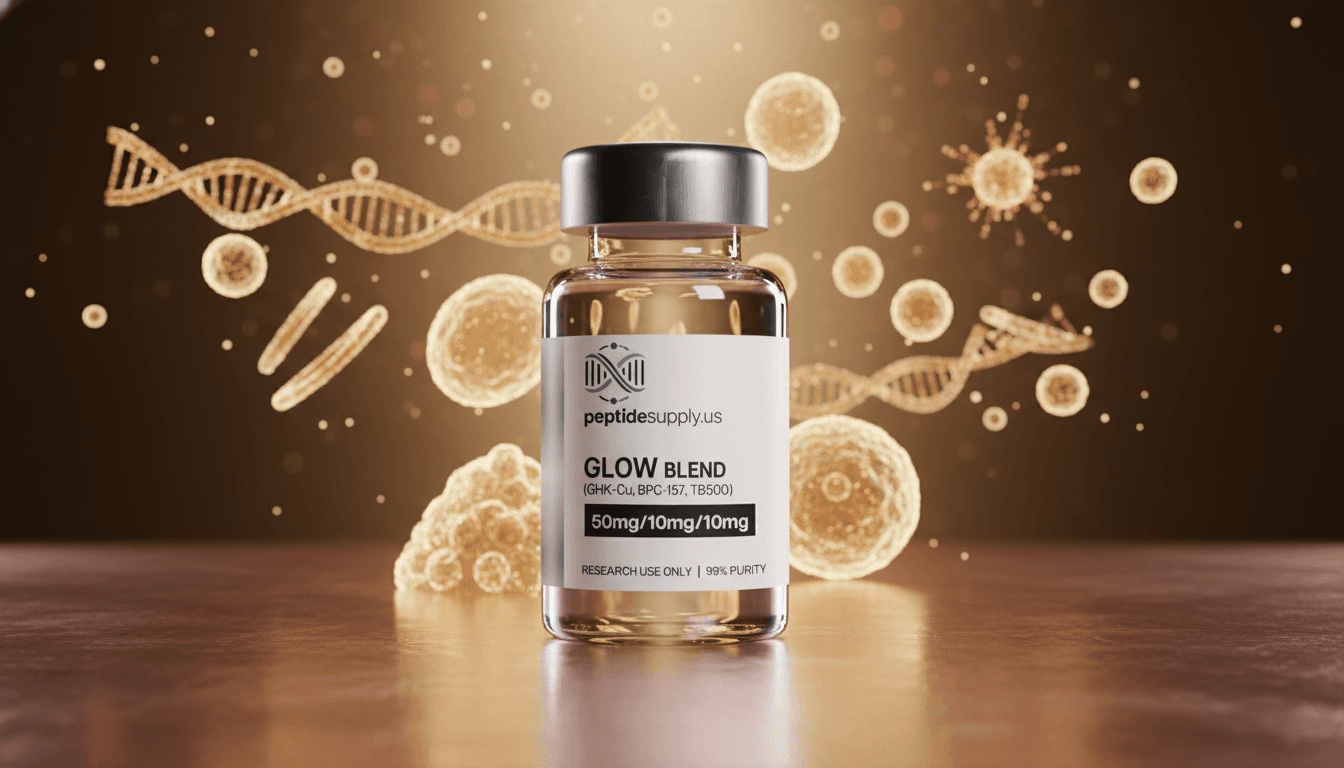
The GLOW Blend: GHK-Cu + BPC-157 + TB-500
Researchers investigating synergistic approaches have explored combining GHK-Cu with BPC-157 and TB-500. The rationale involves triple-pathway complementarity:
GHK-Cu: Gene expression modulation + collagen synthesis + copper-dependent enzyme activation
BPC-157: Angiogenesis + growth factor upregulation + NO system modulation
TB-500: Cell migration + actin remodeling + stem cell recruitment
Each compound addresses a different bottleneck in the tissue remodeling process. GHK-Cu provides the raw materials and genetic instructions. BPC-157 builds the vascular infrastructure. TB-500 mobilizes the cellular workforce.
This multi-pathway approach represents a growing trend in peptide research: rather than maximizing a single pathway, researchers are investigating combinations that address the full complexity of tissue biology.
Delivery Method Research: Topical vs. Subcutaneous
GHK-Cu is one of the few peptides studied extensively via both topical and systemic routes:
Topical Application
GHK-Cu's small size (403 Da) is below the 500 Da threshold generally considered the upper limit for skin penetration. Research has documented:
Effective penetration through the stratum corneum
Local effects on dermal fibroblasts and keratinocytes
Measurable increases in collagen density in treated skin areas
Improved skin thickness and elasticity measurements
Multiple clinical studies of topical GHK-Cu preparations have documented measurable improvements in skin parameters including thickness, density, and collagen content.
Systemic Administration
Subcutaneous GHK-Cu research investigates systemic effects that topical application cannot achieve:
Broader gene expression modulation throughout multiple tissue types
Systemic antioxidant defense upregulation
Effects on tissues beyond the skin (bone, hair follicles, internal organs)
Higher bioavailability to target tissues
The route of administration changes the scope of effects. Topical application provides localized skin benefits. Systemic administration engages the full 4,000+ gene modulation profile across multiple organ systems.
Frequently Asked Questions
Why is copper important in GHK-Cu?
Copper is an essential cofactor for enzymes involved in collagen cross-linking, antioxidant defense, and energy production. GHK without copper shows significantly reduced biological activity. The copper ion activates the enzymatic systems that drive GHK-Cu's tissue remodeling effects. The peptide essentially serves as a targeted copper delivery system.
What does the 4,000-gene finding actually mean?
GHK-Cu modulates expression of approximately 6% of the human genome. The gene expression changes shift patterns from "aged" profiles toward "youthful" profiles — meaning genes that decline with age are upregulated, and genes that increase pathologically with age are downregulated. This is not one gene or one pathway; it's a broad genomic reprogramming effect.
How does GHK-Cu compare to retinoids for skin research?
Retinoids work primarily through retinoic acid receptors (RARs and RXRs) to increase cell turnover and collagen production. GHK-Cu works through copper-dependent enzymatic activation and broad gene expression modulation. The mechanisms are largely non-overlapping, which is why researchers have investigated combination approaches. GHK-Cu uniquely contributes decorin production (anti-scarring), elastin synthesis, and GAG production that retinoids don't directly stimulate.
Does GHK-Cu work topically or does it need to be systemic?
Both routes have documented effects, but different scopes. Topical GHK-Cu penetrates skin effectively due to its small molecular size (403 Da) and produces local dermal effects. Systemic administration engages the broader gene expression profile across multiple tissue types. The choice depends on the research application — localized skin research vs. systemic tissue remodeling investigation.
What makes GHK-Cu different from other anti-aging peptides?
Two things: the scope of gene modulation (4,000+ genes) and the copper delivery mechanism. Most anti-aging peptides signal through one or two receptor pathways. GHK-Cu appears to modulate a significant fraction of the genome through copper-dependent transcription factor activation. Its mechanism is fundamentally different from signaling peptides — it changes the cell's gene expression program rather than just activating a specific receptor.
Key Takeaways
Just three amino acids + copper — yet GHK-Cu modulates over 4,000 human genes, shifting expression from aged toward youthful profiles
Copper is essential — GHK without copper shows dramatically reduced activity; the complex is the functional unit
Collagen, elastin, decorin, and GAG synthesis are all upregulated — improving both the quantity and quality of tissue structure
Natural levels decline 60% between age 20 and 60 — the age-related decline correlates with reduced tissue remodeling capacity
Triple-combination research (GHK-Cu + BPC-157 + TB-500) targets complementary bottlenecks in the tissue remodeling process
FREE RESEARCH GUIDE
The Peptide Blueprint
The GLOW chapter covers the triple-combination evidence — GHK-Cu + BPC-157 + TB-500 research with data tables. 78 pages of peer-reviewed science, free for researchers.
Download Free
At PeptideSupply.us, our research-grade GHK-Cu ships with batch-specific Certificates of Analysis verifying 99%+ purity. Because the science of tissue remodeling deserves research-grade compounds.
Explore our research-grade peptides
All products sold for research purposes only. Not for human consumption. These statements have not been evaluated by the FDA. This article is for educational and informational purposes only.
share